The following is a review of the Japanese imported version of this game,
although the UK version is now available without a financial requirement to
play online.
PSOv2
is the much-awaited 'update' to
Phantasy Star Online
- not a sequel as such, more of an enhancement as it includes the entirity of
the original game with some extras thrown in for good measure. Note, that it's
a stand-alone game - you don't have to have owned/played PSO to play PSOv2.
I've personally spent a HUGE amount of time playing PSO since its US Launch in
February 2001 (almost 500 hours!) and therefore when PSOv2 was released in Japan in
early June I just had to be amongst the first online!
Pay to Play
Unlike the US and UK releases of PSO, Japanese PSO requires you to pay for a
'Hunters Licence' to gain online access. I understand that the US release of
PSOv2 (due in August) will have a similar 'pay-to-play' system. All I can say
is that I hope it's as reasonable as the Japanese system which costs a mere $9 (£6ish)
for 90 days access...
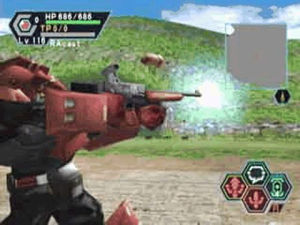
What's New - Offline Mode
Nothing new here until you beat Dark Falz on Very-Hard mode at which point you
gain access to Ultimate Mode. More on this on the Online section below...
What's New - Online Mode
The good news is that PSOv2 players can mingle and play with PSO players as
before, although any V2-specific items they've found will disappear from their
inventories whilst they're playing outside V2-specific games for obvious
reasons.
To find and/or use the new items or play the new game modes, PSOv2 players must
create a V2-specific game. These games are 'invisible' to PSO players although
they're on the same ships and can be in the same lobbies. PSOv2 players also
have access to new lobbies on each ship though (11 upwards) which are where
'Chu Chu Football' is played.
There are also 3 new modes in PSOv2 - Challenge, Battle and Ultimate.
Challenge mode requires at least 2 players (max of 4). Each time you start a
Challenge Stage you are reset to Level 1 with a minimal inventory. The
'Challenge' is to survive and find items as you go - you cannot transport back
for supplies and there are a LOT of monsters to kill as well as puzzles and
co-operative problems to solve. The game continues until ANY player dies at
which point its game over, so co-operation and planning are required to
complete a Stage successfully.
Battle Mode is a 'Quake Deathmatch' Player-versus-Player competition with 4
different sets of 'rules' determining what items can be taken into the arenas,
how long the game lasts and what the objectives are. The arenas are all new
levels called Spaceship and Temple which are exclusive to Battle Mode. They are
quite large and 'windy' with lots of hiding places and warps to keep your
enemies guessing.
Ultimate Mode is set in 'remixed' versions of the existing levels and is where
all your new weapons, items, monsters and bosses are to be found. Put simply,
Ultimate Mode is TOUGH and serious effort is required to progress. The new
weapons are, of course, much more powerful, but they're only found in Ultimate
Mode of course, so there's some 'chicken and egg' going on here!
Other changes
Characters can now develop upto Level 200. If you transfer over a character
from PSO, any EXPerience you gained after L100 is wiped and you're ready to
start working through a further 100 levels. The requirements for gaining new
levels are now VERY high though, so be prepared for a VERY long haul to Level
200!
There's a new Quick-menu on the R&Y key (formerly the alternative Chat option)
which brings up quick-lists of Weapons, Items and Techniques. It's far from
brilliant but it is quite handy - mostly for re-equipping a weapon after being
revived or swapping weapons mid-melee.
If you save a game with at least 100,000 mesetas 'in your pockets', reloading
will offer you the 'Dressing Room' option. In here you can change your Hair
colour/Style and clothes but not your proportions or anything more 'permanent'.
The 100,000 mesetas are deducted on exit of course...
What you don't get
There are no new character types or costumes, although the 'hidden' costumes
from PSO are no longer 'hidden'.
There are no new Techniques either, although it's possible to get higher level
techniques (16 upwards) if you're a Force character (only).
Summary
Ultimate Mode and the trek to L200 is going to be the main attraction of PSOv2.
Certainly, most keen PSO players I know will be happy just to take their
characters on through another 100 levels.
This is fortunate because the rest of the new features are a rather mixed-bag
and none are outstanding additions to the original.
Challenge Mode is quite good fun and it adds some longevity to the game. The
only downside really is that it's time-consuming - with Stages taking at least
45 mins to complete and no mid-game save option.
Battle Mode is less impressive however, the problems are numerous but all come
down to the fact that PSO was not designed with Player-vs-Player combat in
mind. Sonic Team have tried to work around this but the result isn't very
special and won't appeal to everyone - I certainly don't enjoy it.
Chu Chu Football is just a gimmick really, but it could be entertaining for a
short while perhaps ;-)
All in all, I'm pretty happy with my copy of v2 and I will be picking up a US
copy to take my existing characters on the trek to L200 in due course. With
any luck, my Japanese character will have loads of new goodies for them by
then too!
A note on the Import:
I can't really recommend the Import though, as existing players have to start
from Level 1 again and all players have to put up with significant network-lag
problems caused by connecting to Japanese Servers to play.
If you REALLY MUST import PSOv2, feel free to drop me an email by clicking on
my name below and I'll point you to the instructions I used to get online and
running.
GRAPHICS SOUND EFFECTS AND MUSIC PLAYABILITY ORIGINALITY ENJOYMENT
OVERALL
The following is a list of the Phantasy Star Online games reviewed online :
As of April 2009, Blu-rays and DVDs reviewed by the editor are watched on a Panasonic TH-37PX80B
37" Plasma TV with a Sony BDP-1500 Blu-ray player and played through a Yamaha DSP-AX820 amplifier.
PC games reviewed by the editor are on:
Since Jan 2011: Intel Quad Core Dell XPS 8100, i7 CPU 860 @ 2.80Ghz, 8Gb RAM, nVidia GeForce GTS 240, Windows 7
Since Nov 2005: Intel Pentium D 830 3.0Ghz, 1Gb RAM, 128Mb nVidia GeForce 6700XL, Windows XP
Since Aug 2003: Intel Pentium 4 2.66Ghz, 512Mb RAM, 128Mb GeForce4 MX440 graphics, Windows XP
Since May 2003: Intel Pentium 4 2.6Ghz, 512Mb RAM, 128Mb ATI Radeon 9600TX graphics, Windows XP
Since Jun 2002: Intel Pentium III 600Mhz, 384Mb RAM, Windows 98 SE, 64Mb ATI Radeon 8500LE
Since May 2000: Intel Pentium III 600Mhz, 384Mb RAM, Windows 98 SE, Voodoo 3 3000 AGP