This website uses cookies to improve your experience. We'll assume you're ok with this, but you can opt-out if you wish.Accept
Privacy Overview
This website uses cookies to improve your experience while you navigate through the website. Out of these, the cookies that are categorized as necessary are stored on your browser as they are essential for the working of basic functionalities of the website. We also use third-party cookies that help us analyze and understand how you use this website. These cookies will be stored in your browser only with your consent. You also have the option to opt-out of these cookies. But opting out of some of these cookies may affect your browsing experience.
Necessary cookies are absolutely essential for the website to function properly. This category only includes cookies that ensures basic functionalities and security features of the website. These cookies do not store any personal information.
Any cookies that may not be particularly necessary for the website to function and is used specifically to collect user personal data via analytics, ads, other embedded contents are termed as non-necessary cookies. It is mandatory to procure user consent prior to running these cookies on your website.
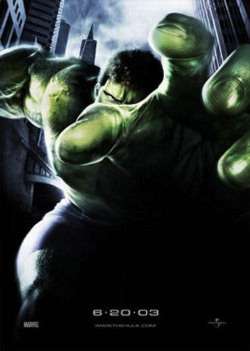
The Hulk is one of Marvel's most successful comic-book properties,
although its impact on the global (i.e, non-US) consciousness is mainly
down to the melodramatic TV series starring Bill Bixby as Dr Bruce
Banner; a man contaminated by Gamma radiation who finds himself able to
transform into bodybuilder Lou Ferrigno whenever he gets angry.
Ang Lee's Hulk swaps melodrama for psychodrama, but remains essentially
the same animal. However, Lee's insistence to film a Greek Tragedy, and
not a vapid "comic-book movie" sees some major changes to the Hulk's
mythology.
In this 2003 update, Bruce Banner (Eric Bana) is an orphan with no memory of
his early family life at a military base, where his father David Banner
(Nick Nolte) tested regenerative techniques on his own cell structure. To go
further would risk two things: confusing you, and robbing the movie of
its only source of narrative originality.
The decision to alter the source material's mythology was brave and,
ultimately, a wise decision. The comic-book's origins would never
sustain a movie, but that doesn't excuse the fact that the plot is
riddled with holes, relies on coincidences, and should prove
indecipherable to the under-12s (who no doubt will be snoring their way
through the movie until the green-meanie appears).
Eric Bana is competent enough as the emotionally distant Bruce, but
fails to make us engage with her rather aloof character. Instead,
Bruce's lack of emotion renders his character fairly inert and he
becomes a frustrating void until the CGI Hulk bursts out of his purple
shorts.
Jennifer Connelly, as Bruce's scientist girlfriend Betty Ross, gives the
best performance of the movie with her mannered and affecting show of
apathy to Bruce's plight.
An extremely scruffy Nick Nolte completes the trio as David Banner, the
mentally fragile father of Bruce whose allegiance is never quite made
clear. Nolte is good value, but the weightiness of his performance often
prompts the question that he's not entirely aware he's in a comic-book
adaptation.
The rest of the cast enjoy their paper-thin stereotyped roles;
particularly Sam Eliott's gruff Colonel Ross and Josh Lucas'
insufferable twerp Talbot.
But it's The Hulk himself audiences are paying to see. So, have
Industrial Light & Magic done Ang Lee proud? Well, yes and no. Early
scenes of The Hulk are worryingly edited and shrouded in darkness,
meaning you can never quite determine the success of ILM's labours. The
sense of power and energy is never in doubt, but quite a few moments
ring false.
A satisfying sequence with an attack from "Hulk Dogs" in a forest (in
darkness, mind you) is more enjoyable, yet still underwhelming because
the Hulk remains shadowed and blurred by speed and movement. At this
stage, you begin to wonder if the effects failed in their mission and
Ang Lee was forced to hide his creation in semi-darkness!
But, once The Hulk's desert scenes arrive (frustratingly late in the
movie) all worries should vanish. It's here where the movie comes alive;
with The Hulk running at 500 mph, leaping hundreds of miles (no,
really!), squatting Apache helicopters, hammer-throwing tanks, biting
the ends of missiles, burying underground, and all manner of other
mayhem. In full daylight! And what a true joy it is to behold.
Ang Lee wanted to make a serious comic-book movie. He succeeded. But, in
doing so, he also stripped the movie of what people really wanted.
There's nothing wrong with treating the source material (no matter how
ridiculous) with respect, but Lee's psychodrama is often quite laborious
and confusingly plotted.
Nobody wanted The Hulk to be just another feast of special-effects, but
Lee's movie fails to even show a solid comedic side. There is just one
funny line (about a "mutant French poodle") and one sight-gag (when the
Hulk bends a tank's gun to point at its occupant). And that's it. Unless
you count creator Stan Lee and ex-Hulk actor Lou Ferrigno's cameo
roles...
Sadly, unlike last year's Spider-Man, the sense of humour is missing
from The Hulk, and only replaced with intermittent spectacle. Audiences
are expected to engage with a trio of quite unappealing characters
emoting through a contrived plot of flashbacks and dream sequences. And
it proves quite difficult to care.
The believability of the drama is often weakened by intrusive
"panelling" (indulgent split-screens to mimic the panels of a
comic-book), that serve to undermine the importance Lee obviously wanted
to place on the characters. If the movie was faster paced and, well,
more fun, the panelling wouldn't seem so inappropriate. Tellingly, it's
only when the movie simply has no option but to be entertaining that the
movie comes alive (i.e., whenever the Hulk is smashing things up).
It's a shame Lee didn't manage this very difficult balancing act of
"arthouse meets blockbuster". But, by overcooking the plot, placing too
much emphasis on father-sibling relationships, and forgetting some
levity, The Hulk devolves into just a mildly engaging drama with a few
admittedly astonishing action set-pieces.
A somewhat disappointing blockbuster, but with some phenomenal moments
and at least desire to do something different with the comic-book
adaptations typified by
X-Men
and Spider-Man.
DIRECTION PERFORMANCES PLOT SCREENPLAY MUSIC & SFX
This website uses cookies to improve your experience. We'll assume you're ok with this, but you can opt-out if you wish.Accept
Privacy Overview
This website uses cookies to improve your experience while you navigate through the website. Out of these, the cookies that are categorized as necessary are stored on your browser as they are essential for the working of basic functionalities of the website. We also use third-party cookies that help us analyze and understand how you use this website. These cookies will be stored in your browser only with your consent. You also have the option to opt-out of these cookies. But opting out of some of these cookies may affect your browsing experience.
Necessary cookies are absolutely essential for the website to function properly. This category only includes cookies that ensures basic functionalities and security features of the website. These cookies do not store any personal information.
Any cookies that may not be particularly necessary for the website to function and is used specifically to collect user personal data via analytics, ads, other embedded contents are termed as non-necessary cookies. It is mandatory to procure user consent prior to running these cookies on your website.